
Industrial Blasting and Wet Painting
Surface preparation and coating to project specification for large, heavy and complex steel pieces — from acceptance to despatch on a single site.
We carry out steelwork blasting, epoxy priming, polyurethane top coats and intumescent fire-protective painting across a 10,000 m² paint shop operation. Coating systems for C3, C4 and C5 corrosivity conditions under ISO 12944 are set up project by project.
- Paint shop operation area
- 10,000 m² (5,000 m² covered + 5,000 m² crane-served yard)
- Blasting routes
- 2 separate lines: automatic turbine + large-piece cabin
- Fire protection
- Water and solvent based intumescent paint
Surface preparation and coating to project specification for large, heavy and complex steel pieces — from acceptance to despatch on a single site.
As one of the largest and most modern industrial blasting and wet painting facilities in the Marmara region, we provide surface preparation and coating to project specification for large, heavy and complex steel pieces.
The 10,000 m² paint shop operation consists of 5,000 m² of covered area plus 5,000 m² of crane-served, concrete-floored storage, drying and packing area. There are two separate blasting routes: an automatic turbine line and a large-piece cabin. Every step from acceptance to despatch runs on one site, without interruption.
Service Scope
- Surface preparation of steelwork, sections, plate and pipe
- OMSG automatic turbine blasting and SAPI large-piece blasting
- Epoxy, alkyd, zinc, aluminium-pigmented and polyurethane wet paint systems
- Project-specific coating systems for C3, C4 and C5 corrosivity conditions
- Water and solvent based intumescent / fire-protective coatings
- DFT, climate, surface profile and final quality checks
- Packing, storage, loading and despatch coordination
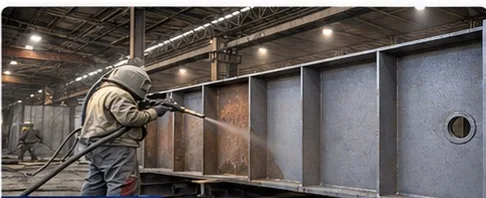
Blast quality decides how long the paint lasts
The performance of a coating system depends on the surface it is applied to. Mill scale, rust, oil or moisture left on the surface will cause even the most expensive system to lift within a few years. Surface preparation is therefore a decision that comes before the choice of paint.
In structural steel the most common requirement is SA 2½ blast cleaning under ISO 8501-1. At this grade most of the surface comes down to a metallic finish; remaining traces and shadows stay within accepted limits. The surface profile is also measured after blasting, because the primer's adhesion depends on roughness.
Why two blasting routes are needed
The automatic turbine line cleans standard sections such as profiles and plate at high speed and consistent quality. As long as the piece fits the line's envelope, this is the most efficient method.
The large-piece cabin is used for members that do not fit that envelope, or that are heavy or complex in geometry: long beams, welded modules, tank shells. Having both routes on one site makes it possible to process the different piece types of a project in one place, without splitting the work.
The paint system follows the corrosivity category
ISO 12944 classifies environments from C1 to CX. In enclosed industrial buildings C3 is generally enough, while coastal areas and plants with chemical exposure call for C4 or C5. As the category rises, so do the number of coats and the total dry film thickness.
Epoxy primer, zinc or aluminium-pigmented intermediate coats and a polyurethane top coat — the components of the system are selected together according to the intended durability. Overcoating intervals, ambient humidity and dew point are written into the application specification.
Intumescent fire-protective paint
Steel does not burn but it heats; above five hundred degrees it loses half its yield strength. Intumescent paint swells under heat to form an insulating foam layer and, because it preserves the profile of the section, it is preferred where the steel is meant to stay exposed.
We apply both water and solvent based systems. Thickness is calculated by member group according to the section factor and the intended fire rating; writing a single thickness into the specification wastes safety on one part of the structure and budget on another.
Measurement and records
During application, ambient temperature, relative humidity, steel surface temperature and dew point are measured; if these are not within limits, application does not start. Dry film thickness (DFT) is taken point by point with a digital gauge and compared against the system requirement.
All records are handed over in the fabrication file. That file is the only reliable reference if a coating problem is ever discussed years later.
Frequently Asked Questions on Metal Blasting and Painting
Yes. Besides our own fabrication, we provide surface preparation and coating for steelwork, sections, plate and pipe supplied from outside. Every step from acceptance of the piece through to packing and despatch runs on one site.
Standard sections are processed on the automatic turbine line. For long beams, welded modules and tank shells that exceed the line's envelope, the large-piece cabin is used. Sharing the piece dimensions at the quotation stage is enough.
Epoxy, alkyd, zinc and aluminium-pigmented systems, together with polyurethane top coats. We also apply water and solvent based intumescent fire-protective paint. The system is selected according to the ISO 12944 corrosivity category and the intended durability.
Yes. DFT measurements, the climate records taken during application and surface profile measurements are handed over in the fabrication file.
Request a Quote for Your Project
Fabrication drawings, a tonnage list or a preliminary design is enough. We review the scope and respond with a schedule and pricing.